
BaZi: The Four Pillars of Destiny
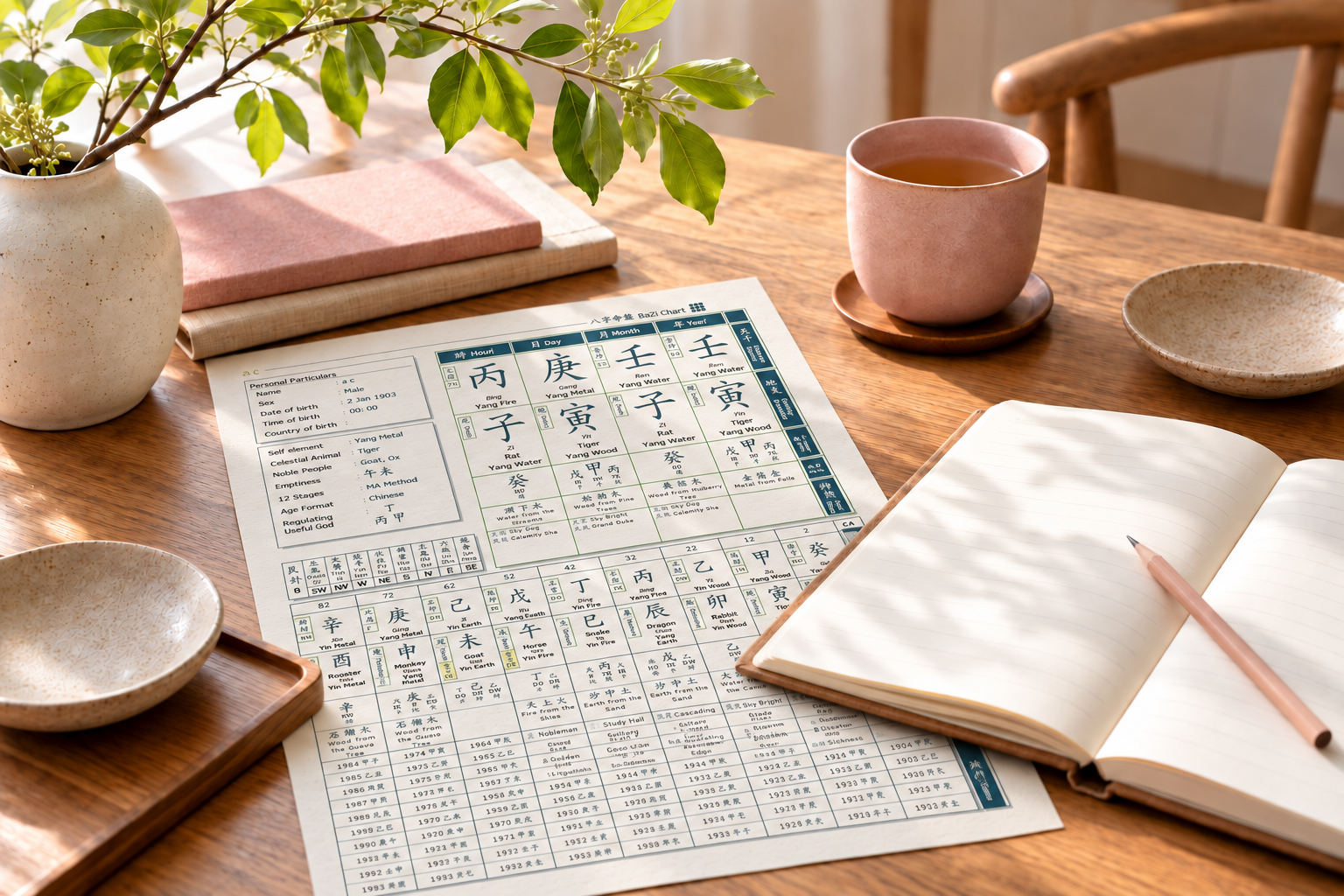
Your birth-year animal is only part of the picture. BaZi offers a more detailed framework within Chinese astrology.
The name Four Pillars of Destiny can sound as though your future is already decided. A thoughtful reading is better approached as a conversation about patterns, possibilities and personal choices, rather than a fixed prediction of what must happen.
What does BaZi mean?
BaZi means “eight characters”. A traditional chart contains four pillars corresponding to the year, month, day and hour of birth. Each pillar has two characters: a Heavenly Stem and an Earthly Branch. Together, they make the eight characters from which the chart takes its name.
These symbols are interpreted within a traditional Chinese metaphysical system. They should be read together, rather than reduced to a single animal or a short list of personality traits.
The Day Master and the five elements
The Heavenly Stem of the Day Pillar is called the Day Master. In a BaZi reading, it acts as a reference point for interpreting the other parts of the chart.
Wood, Fire, Earth, Metal and Water appear in yin and yang forms. Practitioners consider the relationships between them and the seasonal context of the birth month. The balance is more complex than counting how many times an element appears.
A strong or weak chart is not a judgement of your ability or a promise of success.
What can you explore through a reading?
You might arrive with questions about how you approach work, respond to change or relate to others. A reading can offer traditional interpretations to reflect on alongside your own experience.
The most useful conversation makes room for questions. Does an interpretation feel relevant to your life? Where does your experience differ? What would you like to develop, and which choices remain within your control?
Someone who relates to a description of persistence may want to explore when that quality helps them and when flexibility would be useful. This kind of reflection can be more constructive than accepting a label as an unchanging identity.
BaZi and Feng Shui: different parts of the picture
BaZi works with a birth chart; Feng Shui considers the environment. They are distinct practices within Chinese metaphysics, and one should not be treated as a substitute for the other.
When thinking about your home, it helps to keep your personal needs and the actual layout together. A description from a birth chart alone does not explain where a sofa should stand or how a room needs to function.
Preparing your questions
Start with your date and recorded time of birth, and be clear if the time is uncertain. A practitioner may also ask for your birthplace to clarify the calculation method being used.
Bring a few specific questions, rather than expecting the chart to answer every aspect of life. You might consider a recurring habit, a skill you want to develop or a transition you are working through. Clear questions leave more room for a meaningful discussion.
Discover the foundations of Feng Shui.
Continue exploring the relationship between people, their personal perspectives and the spaces they inhabit.