
Feng Shui Tips for a Productive Workspace
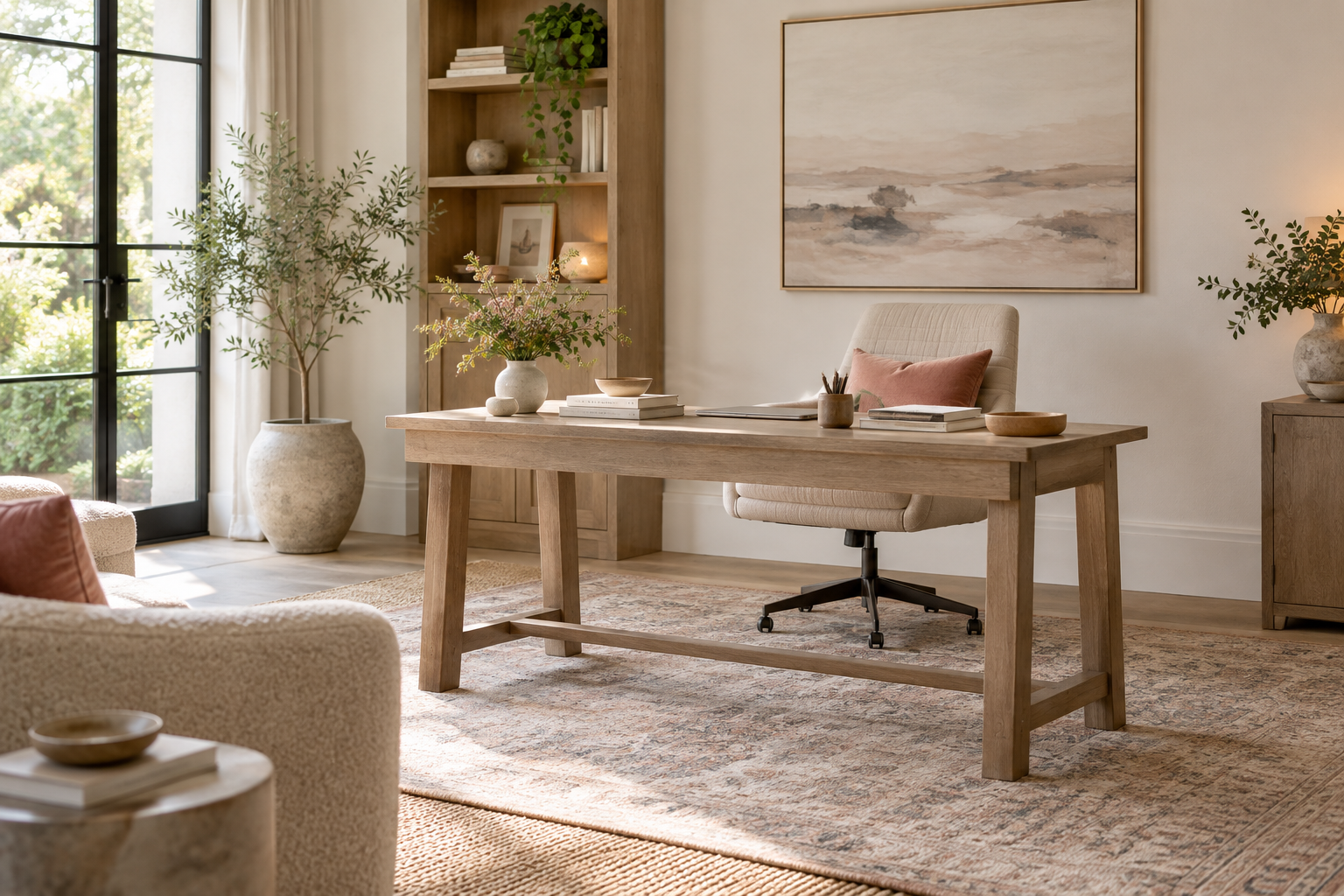
A workspace can look beautiful and still feel difficult to work in. The position of your chair, what you see in front of you and the route through the room all deserve attention before you add another decorative object.
Feng Shui invites us to consider the relationship between a person and their environment. In a home office, that begins with a simple question: does this arrangement support the way you work? These starting points can help you look at your space with fresh eyes.
1. Face into the room, with support behind you
Begin with the place where you sit. In Feng Shui, a supportive arrangement places a solid wall behind your chair and allows you to look into the room. Your desk sits in front of you, rather than leaving you facing a wall with the entrance behind your back.
Ideally, you can see the doorway while seated without being directly in line with it. This is often called the commanding position. You do not need to stare straight at the door: a diagonal view can give you awareness of the entrance while keeping you away from its direct path.
Leave enough room to move your chair comfortably. The aim is a practical working position with a sense of support, not a perfect-looking arrangement that makes everyday movement awkward.
2. Keep the approach to your desk clear
Look at the route from the entrance to your chair. Can you reach your desk without stepping around boxes, loose cables or furniture? In Feng Shui, circulation and the movement of qi are considered together. A clear route is also a practical place to start.
Give paperwork, chargers and equipment a home. Keep the tools you use often within reach and store the rest. A working desk does not have to be empty; it should have enough usable space for the task in front of you.
3. Work with the light you have
Notice the room at the time of day you actually use it. A desk that looks inviting in morning light may become uncomfortable when the afternoon sun reflects across your screen.
Where possible, let daylight reach you from the side and adjust curtains or blinds when needed. Add a task lamp for reading or detailed work, and keep the overall room comfortably lit. Consider the view from your chair as well as how the space looks from the doorway.
4. Bring in nature thoughtfully
A healthy plant, a wooden surface or a view of greenery can add warmth and character. Choose a plant suited to the available light and place it where it has room to grow without blocking a walkway or crowding your desk.
You do not need to fill every corner. One well-cared-for plant can be enough. Choose colours and materials that feel appropriate for your work, rather than treating any single colour or object as a universal Feng Shui remedy.
5. Make the space personal, with intention
Consider what is in your line of sight. An artwork you enjoy or one meaningful object can give your workspace a sense of identity. Keep the selection deliberate so that the things you choose have room to be noticed.
If you work in a bedroom or living room, create a simple way to finish the working day: put away papers, close your laptop and return shared surfaces to their usual purpose. The room needs to support the other parts of your life too.
6. Consider your room and your personal directions together
General advice is a starting point. A more personalised Feng Shui assessment considers the building, its entrance, the surrounding environment and the layout, alongside personal directions calculated from residents’ dates of birth.
For this reason, there is no single compass direction that every desk should face. A useful arrangement needs to make sense for both you and the room. In a small or shared office, we can explore the best available position within the space you have.
Find an arrangement that works for you.
If you are unsure how to position your desk or make better use of a room, a Mini Consultation offers focused guidance for your home or workspace.